

An exclusive interview with the creators of Boof du Jour, the popular satire publication that takes aim at all things cannabis, with a particularly sharp wit reserved for some of the biggest companies in the industry

An image from Boof’s “Trump Announces New “Greener Card” for Cannabis Licensees, Grants Immediate Access to Venezuelan Farmland” article, courtesy of Boof du Jour.
Baseball Hall of Famer Reggie Jackson famously said, “Fans don’t boo nobodies.”
Within the cannabis realm, one might say the same of Boof du Jour, the satire publication that regularly trains its razor-sharp parodies on some of the biggest names in cannabis. Boof du Jour is not taking aim at nobodies — but nobody is entirely safe. Industry giants like Curaleaf, Trulieve and Cookies have all been boofed numerous times.
If you’re paying a celebrity influencer — but not your employees or landlord — you’re probably on the Boof list.
The targets are not just the companies and CEOs. It’s also the industry at large, the culture, the products and the trends. If you can’t laugh at price compression and nonsensical regulations, maybe you should read a different website.
The headlines often have enough truth to trick unsuspecting readers into thinking the stories are not entirely fabricated. They comment with outrage on social media. Relax, it’s satire. No reasonable assessment of these articles would indicate these stories are factual, right? Right? Right?
“Mike Tyson bites off customer’s lip after complaints that Tyson 2.0 edible ears are ‘weak AF.’”
“Our interview with David Tran lasted 72 hours, cost $5,000, and ended with Vegas Metro asking questions we still can’t answer.”
“Adam Bierman launches ‘Weed Empire: The Game Show’ — where social equity applicants battle to the death for a dispensary license he doesn’t even own.”
“Marijuana industry just paid $1 million for a back rub from MAGA.”
Marijuana Venture reached out to Boof du Jour with a bit of an odd question: Would you be interested in doing a serious interview about your semi-serious publication? With the promise to grant anonymity, this is that interview. Enjoy.
Marijuana Venture: What is Boof du Jour, and why did you start it?
Boof du Jour is a daily log of the cannabis industry tripping over its own shoelaces in front of witnesses.
It’s satire, but not the “lol weed” kind. Every piece is rooted in something real that actually happened. Licensing nonsense, compliance cosplay, fake awards banquets, brand launches powered entirely by adjectives and investors discovering, again, that slogans do not count as revenue. We started it because cannabis media mostly lives in two sad houses: press releases wearing fake mustaches or very serious outrage that still somehow refuses to name anyone involved. Boof sits in the alley between those houses, smoking a cigarette and taking notes. It’s not about being right all the time. It’s about saying the quiet part out loud in a way that makes insiders laugh, wince and text it to a coworker with “Fuck, this is us.”
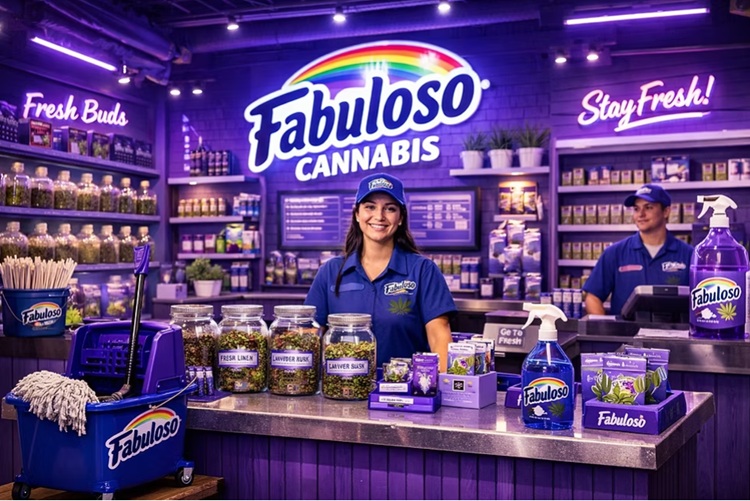
Image from Boof’s “Fabuloso Enters Cannabis, Cites ‘Pre-Existing Dispensary Scent Monopoly‘” article, courtesy of Boof du Jour.
MV: How do you decide what topics to write about?
We follow stress fractures, and we’ve been in this industry long enough to recognize the sound they make.
We’ve spent years inside cannabis watching the same mistakes repeat under different logos, in different states, with slightly different language slapped on top. When something feels familiar in a bad way, it usually is. If five operators independently ask the same confused question in different group chats, that’s a story. If a regulator releases guidance that technically checks out but practically detonates an entire workflow, that’s a story. If a brand launches something so over-described it reads like a wine menu written by someone who’s never used the product, that’s also a story. Most Boof pieces start with someone saying, “Am I insane, or is this completely broken?” We’re not hunting villains. We’re documenting patterns. When the same behavior keeps popping up across companies and markets, it usually means the system itself is doing something very funny and very wrong.
MV: Do you use metrics to decide what to publish, or mostly intuition?
Both, but judgment leads.
Metrics tell us what hit, what got forwarded privately, and what caused a spike in DMs that begin with “holy shit.” That matters. But metrics don’t tell you what’s about to snap, or what people are quietly furious about while pretending everything is fine.
The strongest stories come from reading the room. Group chats, off the record calls, leaked screenshots and that exact moment when laughter stops and everyone exhales at once. Metrics help sharpen the joke. They don’t write it.
MV: On your site, you ask: “What’s your Problem, Pitch or Petty Grievance?” Any memorable submissions?
Relentlessly.
We get everything from genuinely helpful tips to absolute midnight novels written by someone who just survived a board meeting and needs to process it publicly. The funniest ones aren’t the angriest. They’re the eerily calm emails that start with, “I don’t know if this is illegal, but …” followed by three PDFs, a timeline and a Google Drive link labeled “FINAL_FINAL_v7.”
Those are gold. Not because they want blood, but because they’re trying to understand how something so obviously dumb became normal.

Image from Boof’s “MSO CEO Goes to Ayahuasca Retreat to Become Better Person, Returns Somehow Worse,” article, courtesy of Boof du Jour.
MV: Have you ever received a grievance that made you delete a story, or consider it?
Delete? No.
We’ve had threats, legal adjacent emails, dramatic phone calls and several people suddenly develop a deep philosophical appreciation for satire the moment they recognize themselves in it. We’ve also been offered money, actual real-world payments, to “just quietly take something down” or “reframe the narrative.”
That answer is still no.
What we do care about is accuracy. If someone shows up with receipts and says, “This part is wrong,” we’ll fix it. Immediately. Facts matter.
But discomfort isn’t a correction. Embarrassment isn’t libel. And “this makes us look bad” is not an editorial argument.
We’re not here because we think we’re always right. We’re here because this industry survives on silence, proximity, and people being too polite or too financially entangled to laugh at the obvious. Boof exists to laugh anyway.
MV: I know you want to remain anonymous, but what can you tell us about the person/people behind Boof?
Boof is not an algorithm and it’s not a marketing intern doing “edgy content” for engagement. It’s more than one real person, with real jobs, real relationships and real context inside this industry. We’re insiders, which is the entire point. You can’t write this kind of satire from the outside without defaulting to lazy stereotypes, or missing the fucking punch line.
We’re pro-cannabis and pro-operator. We love weed. We also love the people who are trying to build something legitimate in an industry that routinely rewards the loudest PowerPoint instead of the best execution. Boof isn’t anti-weed. It’s anti-bullshit. There’s a difference, and most people in cannabis can feel it immediately.
As for writing, we’ve been writing professionally for a long time, just not always with our name on the byline. In cannabis, “writing experience” usually means you’ve written everything from compliance language to marketing copy to internal SOPs to the polite email that starts with “per my last message.” Boof is what happens when you take all that and stop pretending the chaos is normal.
MV: How much do you utilize artificial intelligence in producing your content?
Is AI involved? Sure. We use tools where tools make sense, especially for visuals. But the voice, the targets, and the underlying truth are human. AI can imitate tone. It can’t replace lived context or instinct for where the industry is lying to itself today.
Boof is a business, in the sense that we treat it like one. We invest real time, money and creative energy into it. We’re building something meant to last. But it’s not a business in the “please sponsor us so we can soften the punchlines” sense. If the price of scaling is losing the voice, we’d rather stay smaller and meaner.
Anything else we can say? Boof is funny, but it’s not a joke. It’s a fucking receipt book. It’s culture reporting for an industry that too often confuses hype for reality and calls it “growth.” We’re here for the long run.
MV: From a statistical perspective, can you share a story that really generated an abnormal amount of traffic?
The funniest part is that one of the biggest spikes we’ve seen wasn’t even a story. It was a simple post: “PETITION: Let Boof du Jour Run HIGH TIMES Magazine!”
That post lit up because it hit an exposed nerve. The comments, the reshares, the private messages, the mix of people chiming in from every level of the industry. It wasn’t just “haha funny”; it was people signaling that they miss cannabis media that feels alive, irreverent and honest. That moment was a quiet proof point that Boof isn’t just an inside joke, it’s tapping into a real appetite for something the industry used to have and somehow lost.

Image from Boof du Jour’s “BREAKING: Kyle Kazan Replaces Undocumented Workers with Oompa Loompas, Declares Himself “Mr. Wonka” of Weed,” article, courtesy of Boof du Jour.
MV: Do you have a personal favorite story?
It changes, but the stories that stick with us are the ones where a real situation gets told through the Boof lens and suddenly the whole thing becomes impossible to ignore.
Cannabis has entire corners of its foundation built on buzzwords and capital, people rich enough to avoid learning anything about the plant, the customers or the day-to-day reality of running a functional business. Those are the stories I love most, not because they dunk on someone, but because they put language to what everyone’s been watching happen in slow motion.
And it’s worth saying: Boof isn’t just a satire engine hunting for victims. We want to highlight people doing it right too. Great operators, great brands, great products, real builders. The industry is full of them, they just don’t always have the loudest microphone. The long-term goal is a community where you can spot the signal immediately, the people who see the game, want it to be better and are still willing to laugh while they build.
MV: Writing satire in 2026 feels like a lost art. Why do you see satire as an important medium for highlighting the ridiculousness in cannabis?
Because cannabis has become a place where reality routinely reads like parody, and everyone is trained to nod along.
Satire works because it collapses the distance between what people say out loud and what everyone knows privately. It makes the contradictions visible. It names the pattern. It takes the thing the industry has been politely stepping around for years and puts it under a bright light with a caption that says, “No, you’re not fucking crazy. This is as stupid as it feels.”
Cannabis is still young, and some ignorance is expected. What isn’t excusable is repeating the same bad decisions in every state, in every cycle, with the same recycled language and the same confidence. Satire is a pressure release valve, but it’s also a corrective lens. It gets people to engage without a lecture, and it gives the industry a way to look at itself without immediately hiding behind PR.
Sometimes the most honest way to tell the truth is to say it in a voice sharp enough that nobody can pretend they didn’t hear it.