


Mind Right Exotics eventually came to Maryland through a partnership with BLVCK MRKT, a Black-owned cultivator with its own relationship with cannabis.
Back in the late ’90s and early 2000s, cannabis didn’t have legality. What she had were communities carrying her through neighborhoods, into studios, and into the hands of those who helped us heal through words and melody.
She didn’t have dispensary shelves or colorful packaging. There were no celebrity cannabis brands, launch parties, or licensing deals. Her name still carried heavy consequences. For many, being caught with her could change the direction of a life, even as she quietly helped shape the soundtrack playing behind it. Hip-hop knew her well.
The relationship wasn’t manufactured for marketing because there was nothing legal to market. Cannabis lived inside the culture, and the artists telling stories about where they came from carried pieces of her story with them. Memphis Bleek was one of them.
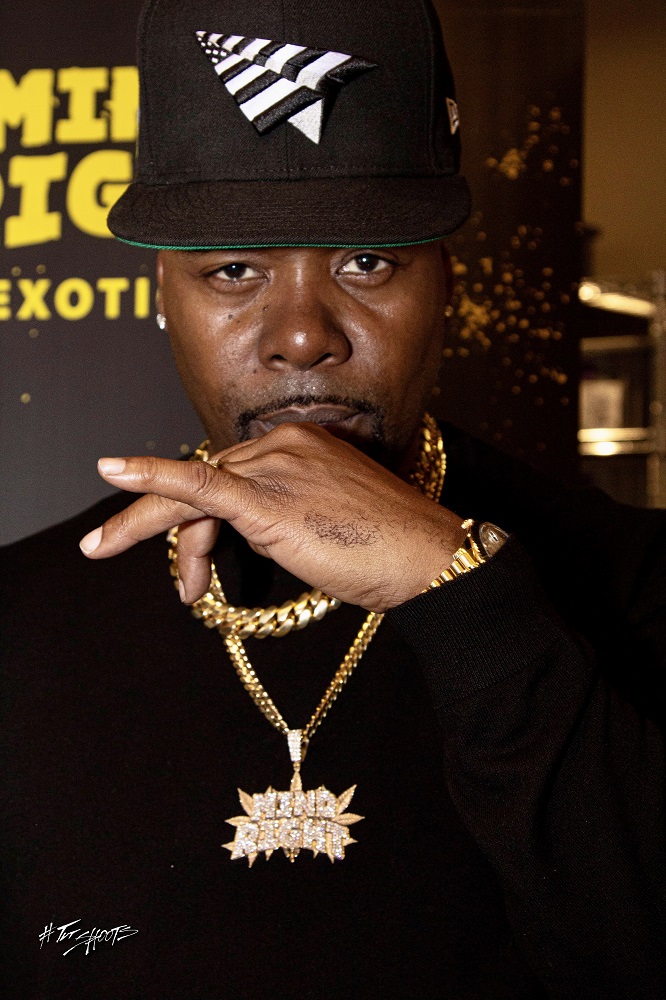
Malik Cox, aka Memphis Bleek.
Before cannabis became a legal business opportunity, before Mind Right Exotics could exist on a Maryland dispensary shelf, and even before Memphis Bleek became a name known around the world, Malik Cox knew the plant. He smoked her. Sold her. Caught cases for her. Ran from police because of her.
The man who admits he understood selling weed better than he understood how anyone could make a living as a rapper would go on to spend decades doing exactly that. Records, tours, and Roc-A-Fella became part of his story, while the plant continued traveling her own long road toward legalization.
By the time that road opened into legal ownership, Bleek was no longer the kid who knew how to sell weed, and cannabis was no longer a business that had to be built in the shadows. Both had changed. The opportunity changed, too.
Legalization offered artists with real roots in cannabis something celebrity endorsements never could: the chance to move from representing the culture to owning something within the industry it helped create. But ownership asks more of you.
A famous name can create attention. Cultural credibility can create trust. Neither can keep a plant alive, build infrastructure, navigate regulation, or turn a moment into something the next generation can inherit. That takes people willing to build.
For Mind Right Exotics, that work eventually led to Maryland’s Eastern Shore and BLVCK MRKT, a Black-owned cultivator with its own relationship to the plant, business, and the opportunity legal cannabis could create. What followed took almost a year.
There were genetics to revive, environments to dial in, standards to meet, and plants that occasionally needed what the teams jokingly described as CPR. Behind a partnership involving one of hip-hop’s recognizable names was something decidedly less glamorous: patience.
That is where the story about this Maryland partnership begins.
Not with Memphis Bleek the rapper entering cannabis, but with Malik Cox the businessman proving that history with the plant does not exempt anyone from doing the work required to build with her legally.
Hip-hop helped carry cannabis long before legalization arrived. Now that the doors to legal ownership have opened, cultural roots may help an artist walk through them, but access comes with an opportunity to build something that outlives the moment. Something that creates ownership instead of another endorsement. Something that creates opportunity instead of simply extracting profit. Something the next generation can inherit, build upon, and point to as proof that there was a place for them here, too.
For the artists who once helped carry the culture, perhaps that is the assignment now: build something that lasts, leave something that inspires.
Mind Right Exotics x BLVCK MRKT: Built on standards, strengthened by alignment
By the time Mind Right Exotics and BLVCK MRKT found each other, both sides had already experienced enough to know what a wrong fit felt like. As I listened to both sides tell me how this partnership came together, the wrong fits became just as important to the story as the one they finally got right.
On the Mind Right Exotics side were: founder Malik Cox, also known as the artist Memphis Bleek, and CEO Fred C.; longtime friends, business partners, and entrepreneurs whose relationship with cannabis stretches back for decades. Representing BLVCK MRKT was Brandon L. Wyatt, co-founder of MAS Alliance, the house behind the Maryland cultivation brand, along with the team, which includes Seth Murphy, CEO/co-founder, responsible for bringing Mind Right’s genetics into its Federalsburg grow.
Both came with history, both came with expectations, and both had something to prove. For Bleek and Fred, it started with the flower.
“You never want to compromise the integrity of the product,” Bleek said. “Because then once you do that, you compromise the integrity of the brand.” Fred made the standard even simpler: “We don’t want to put our name on something that we ain’t smoking.”
BLVCK MRKT had something to prove, but so did Mind Right. For Wyatt, the famous name wasn’t enough. BLVCK MRKT wanted partners who were going to participate in the business, not just appear on the packaging.
“Our non-negotiable is that they actually were entrepreneurs,” Wyatt said, emphasizing people willing to be involved, “grow, learn, teach, and contribute to the relationship.”
Before anyone could call this the right partnership, they had to grow through it. What followed was nearly a year of working with Mind Right’s genetics and learning what the plants needed inside BLVCK MRKT’s facility. Different cultivars required different lighting, temperatures and environments, and a decision made in the grow could take months to reveal whether they got it right. When I asked where the partnership had hit friction, nobody brought up money, contracts, or egos. Instead, the room erupted over the memory of incoming clones struggling to stay alive.
“Brandon was over there giving CPR to some of these clones,” Bleek joked. The process gave the teams something else: time to learn each other. Bleek talked about finally working with people who understood where he and Fred came from, people who “talk like us” and understood their vision.
Fred noticed how BLVCK MRKT kept its facility, how seriously the team took plant health and flower quality. Both sides also came to the table with women in positions that helped drive their teams; another point of alignment that quickly turned into the men enthusiastically shouting out the women doing the work alongside them.
Wyatt has a phrase for determining whether what two sides bring to the table actually works together: “fit and finish.” Bleek and Fred laughed when they realized there was a business term for something they’d already been talking about in their own language.
“A lot of people chase the dollar,” Bleek said. “Some people are just passionate about the product and passionate about the brand. When the brand and the product has passion, the money is gonna chase you. When you chase the money, it runs from you.”
The flower aligned, the business aligned, and just as importantly, the people aligned. As the team put it during our conversation:
“They don’t give you awards for being fast. They give you awards for being right.”
What it means to pour back into Maryland
For Mind Right Exotics, Maryland isn’t new territory. Long before Bleek was preparing to put new Mind Right flower on dispensary shelves, the DMV became a part of his story. He remembers WPGC as the first radio station he visited when his debut album dropped, back when BET was still based in Washington, D.C. For an artist from Brooklyn, that love he received early on stayed with him.
“The whole DMV embraced me,” Bleek said. “So I always reciprocated the love back.”
Bleek doesn’t talk about Maryland like a market he discovered after legalization. He talks about people who supported his music, communities he has returned to over the years, and a place that reminds him of home.
“Baltimore to me is like Brooklyn back in the days,” he said. “It’s a hidden gem that has so much talent, so much love in the city that it just needs the light shined on.”
 There is history on the BLVCK MRKT side of the partnership, too, although of a different kind. The company grows on Maryland’s Eastern Shore in Federalsburg, Caroline County, land that carries a much older Black history. William Still, remembered as the “Father of the Underground Railroad,” was born to parents Levin and Sidney Steel/Still, who had been enslaved in that region before escaping bondage.
That history belongs to the Still family, but the reference is worth mentioning because generations later, a Black-owned company is putting down agricultural roots on that same Eastern Shore, cultivating a plant whose prohibition would create another complicated chapter between Black communities, freedom and the law.
Today, BLVCK MRKT is growing there legally, with an opportunity to make that growth mean more than what comes out of the soil. For Wyatt, building in Maryland has to mean creating room for other people to build, too.
During our conversation, he spoke passionately about the difficulty minority- and women-owned companies face trying to find space in an industry increasingly dominated by larger operators. His response wasn’t simply to talk about equity. It was to talk about work.
BLVCK MRKT needs salespeople. Brand representatives. People who want to learn the industry and participate in what is being built. The invitation from Wyatt was direct: “if you want to work in cannabis, reach out.” That carries different weight in cannabis.
Companies like BLVCK MRKT have an opportunity to turn some knowledge, curiosity, and connection to cannabis into legal employment, entrepreneurship and ownership. Bleek understands that contradiction personally. He has talked openly about catching cannabis cases in New Jersey and New York, about running from police, and about how surreal it feels to now participate legally in the same industry.
Maybe that’s also why community seems to sit so close to the business for him. He doesn’t want to be one of the artists who comes into a city, benefits from its support, and forgets about the people once the transaction is complete. Maryland supported him before there was a Mind Right product for Maryland to buy. Now, he has something different to bring back.
For Bleek, the real return isn’t measured only at the register. It’s in meeting someone who remembers seeing him 20 years ago, taking the picture, giving the hug, and hearing the story of what his music meant to somebody long before either of them could have imagined meeting again through legal cannabis.
“When you really get to meet the people who support you, that is better than the check to me,” Bleek said, “because then you know what you’re doing it for, there’s purpose.”
Memphis Bleek/Malik Cox: The artist was always an entrepreneur
Before the interview started, I had one question I hadn’t written down: do I call him Bleek, or do I call him Mr. Cox?
I spent my late teens and beyond listening to Memphis Bleek. Picture it, early 2000s, my home state of Florida; driving my two-door Acura Integra with two 10-inch subwoofer speakers in the back, blasting: “Is That Your Chick,” while dancing in my seat. But this interview wasn’t about music. I was meeting with an owner of Mind Right Exotics to talk about cannabis and business, and for the first time, “Memphis Bleek” didn’t feel like the obvious way to address him.
Turns out, the distinction between the artist and businessman was already part of the conversation on the other side. For Wyatt, it mattered when BLVCK MRKT considered the partnership. “There’s a difference between a business person and someone who’s willing to have their likeness appropriated,” he said.
Bleek wasn’t new to either cannabis or business. He was selling and smoking cannabis before his career in hip-hop took off. He caught cannabis cases in New York and New Jersey, and laughs now at how differently his life might have gone had the legal industry existed then.
“If you would have told me when I was a kid that this would be possible, I probably would have chosen selling weed before rapping,” Bleek said. “Because I knew more about selling weed than I knew about rapping.”
The rap career obviously worked out, and before Mind Right Exotics launched, Bleek and Fred launched other businesses together. They have known each other since the ’90s. Their friendship moved from smoking weed and doing shows to “thinking of plays,” and eventually into multiple business ventures together. The two men sitting in this cannabis interview had already decades learning how to do business together.
One of the easiest mistakes for successful people entering cannabis is assuming success in another industry makes them an expert in this one. Bleek and Fred didn’t need to learn how to grow commercial cannabis to build Mind Right. They needed to know enough about the plant, their consumer, and their own standards to recognize who could do that job better than they could. That’s where BLVCK MRKT enters the equation.
Mind Right brought a brand, a Maryland customer base, cannabis knowledge, and two entrepreneurs who knew what they wanted their product to be. BLVCK MRKT brought cultivation, genetics, and the infrastructure to grow it.
Nobody had to pretend to be the other.
Getting the Mind Right: From a name to a mission
Some names are created for a product. Others grow into their meaning. It would be easy to trace Mind Right Exotics directly back to “My Mind Right,” the Roc-A-Fella-era record Bleek released more than two decades ago. The words were already his. Except, according to Bleek, that isn’t the story.
Mind Right, he explained, is rooted in something much more personal: mental health, healing and the idea of finding a little peace in a world that doesn’t always make that easy. For him, cannabis has long been one of the things that can help quiet the noise.
And his vision for Mind Right doesn’t end with flower. He sees room for conversations, programs and even literature, ways to reach people who may need help getting their mind, body and soul into a better place. Maybe that’s why this partnership feels bigger when the conversation turns toward what comes next.
BLVCK MRKT isn’t only talking about how much cannabis it can grow. Wyatt talks about creating jobs and bringing more people into the legal industry, particularly as minority- and women-owned businesses fight for space to survive. Mind Right isn’t only talking about how many bags Bleek’s name can move. Bleek and Fred talk about building something people can see themselves in.
Near the end of our interview, I asked them to imagine five years from now. Imagine cannabis is legal, the industry is thriving and somehow, through all the chaos of building it, we made it. What should someone remember about this moment?
Bleek’s answer had nothing to do with being famous: “Anybody can do it,” he said.
He talked about being regular people who smoked weed, caught cases, ran from police and cut school, then taking what they knew and turning it into an opportunity to empower themselves and their people. The point, he said, is for someone else to see what they built and think: “If he can, I can too.”
Maybe that is what the right fit looks like after all: not two partners bringing the same things to the table, but two sides knowing what they carry, respecting what the other carries, and building something neither could have built quite the same way alone.
close to a year of getting the flower, the partnership, and the details right, Mind Right and BLVCK MRKT are taking that message directly to Maryland.
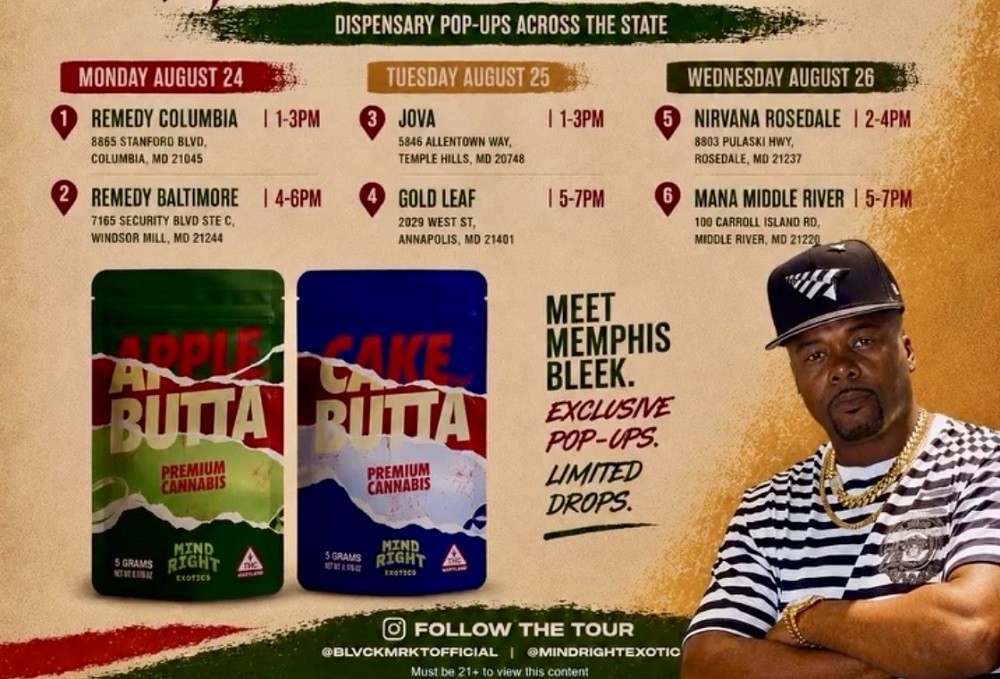
The launch tour begins Monday, August 24, with stops at: Remedy Columbia from 1–3 p.m. and Remedy Baltimore from 4–6 p.m. On Tuesday, August 25, the team heads to JOVA from 1–3 p.m. and Gold Leaf from 5–7 p.m. On Wednesday, August 26, at Nirvana Rosedale from 2–4 p.m. and Mana Middle River from 5–7 p.m.
Six stops over three days. A chance for Bleek to do exactly what he said matters more than the check: meet the people, take the pictures, give the hugs, and return some of the love Maryland gave him first.
Screenshot