


Massachusetts legalized recreational cannabis in 2016, with sales beginning in November 2018. Since then, adult-use cannabis crossed the $8 billion gross sales mark by June 30, 2025, with the total reaching $8.033 billion by July 11, 2025 . Boston, in particular, has led the nation in cannabis social equity programs and collected some of the highest local cannabis revenue in the state. Yet within that rapid market expansion and regulatory framework, three dispensary operators across the city offered a different kind of insight during the State (of) Flower Tour’s Boston stop.
Hosted by the City of Boston, Mayor’s Office of Economic Opportunity and Inclusion, State (of) Flower Tour leaders/partners: Veronica Castillo and Dasheeda Dawson, visited three Black-founded/owned Boston dispensaries and captured the forward-thinking conversations shaping the city’s cannabis future. We arrived as authors, consumers, regulators, storytellers, and active listeners, engaging directly with Fire Brand Cannabis, The Heritage Club, and Prolific Dispensary founders to understand their vision for collaboration, grants and technical assistance, and ecosystem support. These conversations document how Black/brown business owners are actively building the industry infrastructure they want to see. What these founders shared matter, for policy, media coverage, and how the next markets learn from Boston.
The conversations that happened in these spaces weren’t just about current operations, they were about vision, what’s possible, and the industry these owners are actively shaping. Fire Brand provided insight into what happens when four social equity applicants refuse to compete and build together instead. Heritage Club represents what it looks like when equity-created operators with real stakes in their communities show up when the industry itself is under threat. Prolific is shared insights on ecosystem requirements for actual success, the support systems, the people, the infrastructure that needs to exist. Each dispensary operates individually but collectively, they’re thinking strategically about what the cannabis industry actually requires to function equitably.
FIRE BRAND CANNABIS: Collaboration and Co-Creation
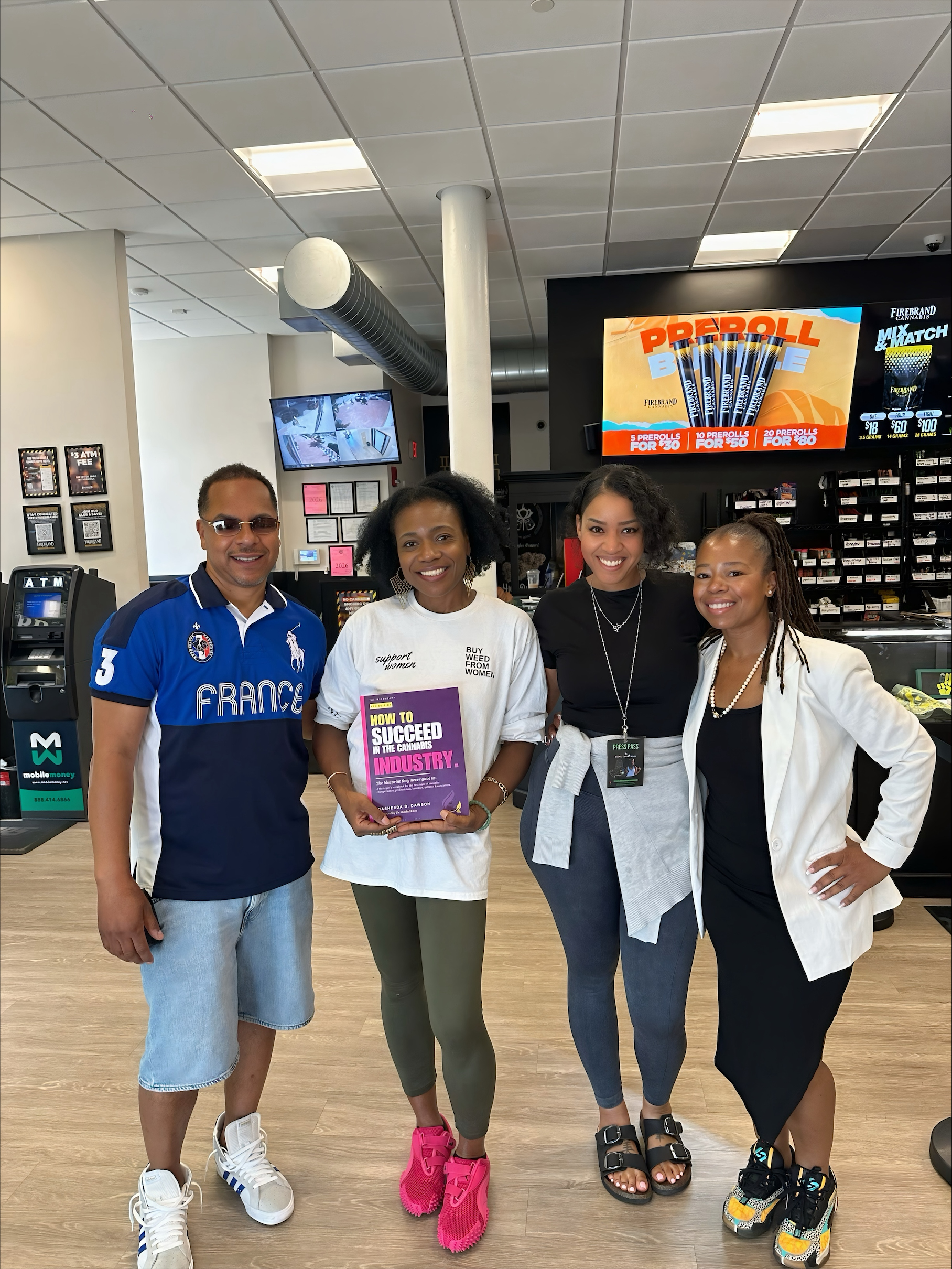
Albie Montgomery, Dasheeda Dawson, Veronica Castillo and Drudys Ledbetter, BSN, RN, at Fire Brand Cannabis (© Shekia Scott)
Fire Brand Cannabis sits on Atlantic Avenue in the Leather District, directly across from South Station, positioned to serve the melting pot of communities that make up downtown Boston. The location is as intentional as the four social equity applicants who built this dispensary together, refusing to pursue separate licenses and compete against each other. Instead, they chose collaboration as their foundation, and that choice shapes how Fire Brand operates.
The State (of) Flower Tour visited Fire Brand and toured the dispensary with co-founder, Albie Montgomery, who described the founding philosophy directly: “This is the story of a group of social equity applicants collaborating. This is what success looks like when everyone reduces their ego size.” It’s not sentimental. It’s structural. Four people who could have gone solo, but didn’t. Albie shared: “A lot of people want to do solo, but I think of and believe in: you’re better in numbers. At this point in time, we’ve got more power in collaboration than going solo.”
That power translates into something tangible when walking through the second floor. A large space with multiple rooms all separated like bedrooms. It was very easy to visualize: yoga classes, training sessions, small gatherings, and workshops. Albie sees endless possibilities; “a cannabis training school, a music studio, a podcast studio, and more.” This isn’t theoretical planning, it’s active development. Albie walks through the space and sees what collaboration makes possible: “This is ours. Our space. This industry is supposed to be ours. So I’m making sure we all have enough knowledge to grow in this space.” The four founders aren’t just sharing ownership, they’re building shared capacity, shared knowledge infrastructure.
The economics of Boston’s cannabis market reinforce why collaboration matters. Real estate is expensive, margins are thin, and the legacy market still competes. Fire Brand works on operating smarter. “Many black/brown/minorities don’t have the money to get into the industry. But when we do get in, I don’t think we spend as much money because we don’t have it to burn.” They’re not hiring expensive lawyers and consultants to tell them what they already know from living in this community, Albie added “we know because we are a part of the community and culture we serve, and we spread knowledge.This is for us, by us.”
THE HERITAGE CLUB: When Equity Operators Show Up
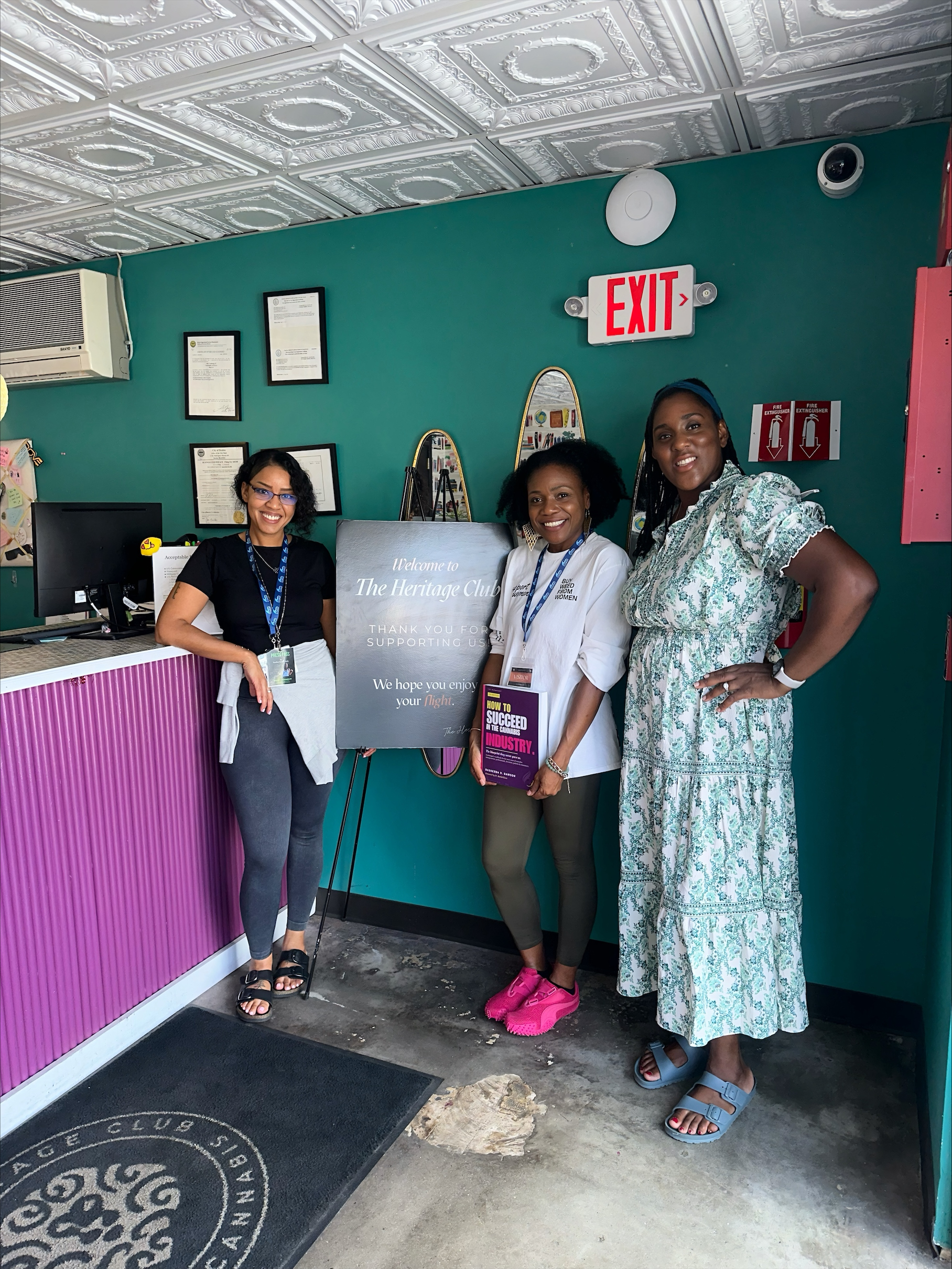
Veronica Castillo, Dasheeda Dawson and Nike John at The Heritage Club. (© Shekia Scott)
The Heritage Club dispensary sits on Cambridge Street in Charlestown, and is the first Black woman-owned dispensary in the neighborhood. Founder and owner, Nike John, navigated Boston’s equity framework deliberately: community board approvals, neighborhood liaisons, local ownership requirements. But that framework faces a test. There’s a ballot initiative to repeal adult-use legalization in Massachusetts. Nike shared: “I don’t think it’s going to pass. I just think the fact that it’s even a discussion point, that it has made it to the ballot, is crazy. It’s like, what is happening?” The repeal threat reveals something essential about how different kinds of operators actually show up when cannabis itself is threatened.
The big multi-state operators talk about supporting the industry. But when it matters, when the ballot initiative is real, when voter education is critical… they’re nowhere. “So when we’re talking about the repeal, you’re not seeing them out. You’re seeing the people from Massachusetts who work there out, but you’re not seeing owners speak at all.” Nike, by contrast, is mobilizing. Getting flyers to customers. Making sure people understand what they’re voting on. “They’re banking on us being kind of communes and just quiet about it.” But the equity program created different kinds of owners, ones with actual stakes in whether this industry survives. “I feel like that’s why it’s so important when we’re doing something that’s creating change that the ownership and everybody, at least at some percentage, is involved.”
That difference matters because equity programs don’t just hand out licenses, they create operators with capacity to build long-term. Without the technical assistance, without grants for lawyers and carpenters, without the city and state funding, owners would be in pure survival mode. “Without these grants I may not be here. One of my investors was like, ‘are you running a business or are you getting grants?’ I was like, do you want me to close?” Nike is invested and shows up politically. She’s thinking about what her business means for her neighborhood.The equity framework enabled full participation, not just entry; that’s what the industry needs when legalization itself is under attack.
PROLIFIC CANNABIS DISPENSARY: Systemic Support & Ecosystem Building
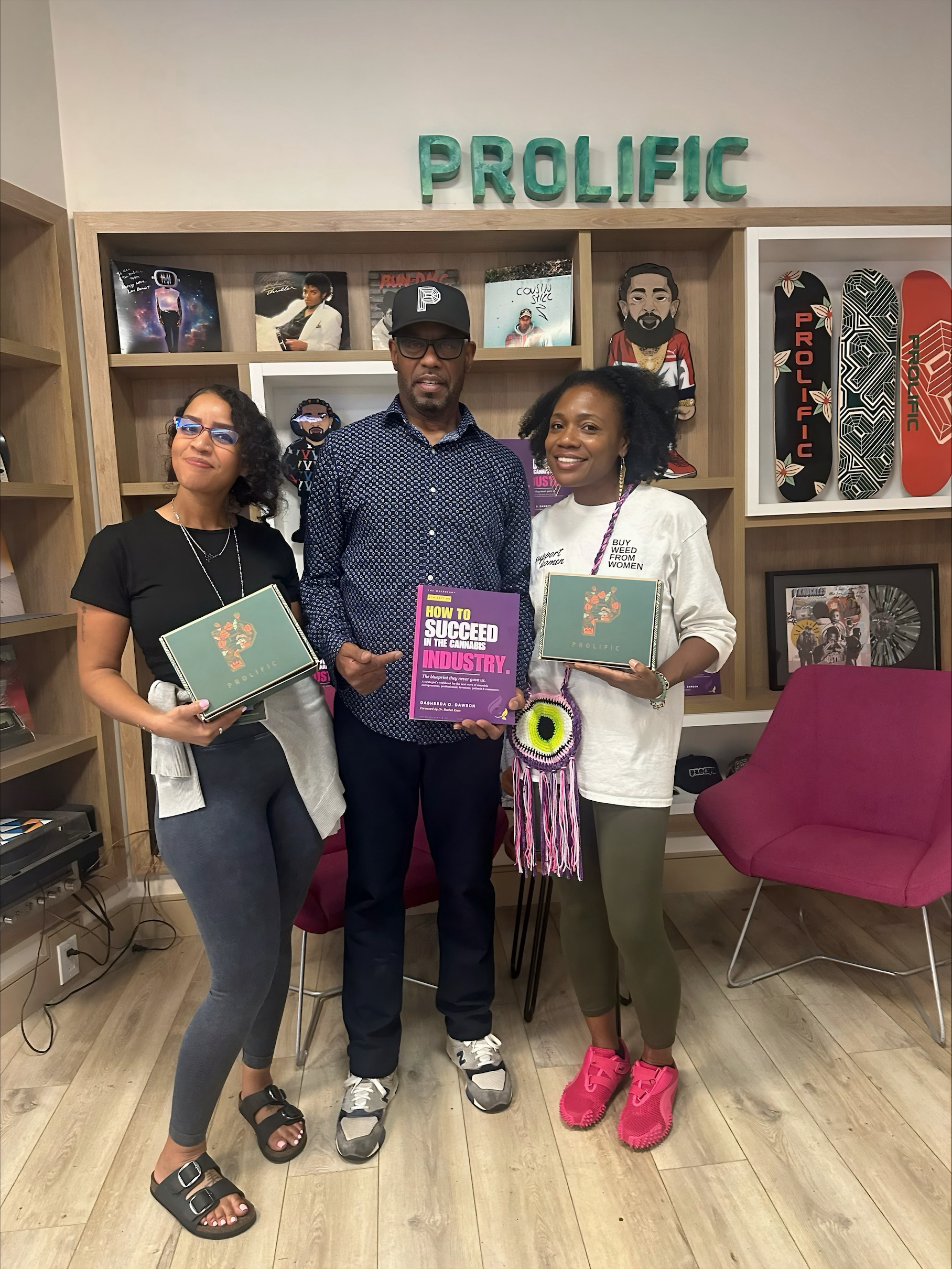
Veronica Castillo, Eric Lawrence and Dasheeda Dawson at Prolific Cannabis.(© Shekia Scott)
Prolific Cannabis sits at Harvard Avenue in Allston, a neighborhood of constant motion: students, young professionals, an overall transient community. The dispensary opened just three days before 4/20, as a Social Equity Licensee with local Black ownership. The space itself reflects high vibrations and appreciation of the arts: a deli-bar model, local artist walls, a business built deliberately for communities most impacted by prohibition. But opening here, being last to market with four competitors within a half mile, required more than ambition.
Founder Eric Lawrence shares: “I’ve got competition on all four sides of me within a half mile and I’m last to the game in opening this location, which made it a little more difficult to get up and running.” The carrying costs were a heavy burden. He went on to share: “You find the spot and now you’re paying rent on it. You pay rent on it for two years before you start. That’s the biggest hurdle- the carrying costs. It’s almost impossible.” But then he shared insight on state funding coming through. “I got a check and was like, ‘yeah, I appreciate this’.” Eric discussed that with the funds received, paired with technical assistance, marketing support, and accounting cycles changed what was possible: “The Technical Assistance program that Shekia Scott created is truly one that just lets the entrepreneur be the entrepreneur.”
The regulatory environment mattered equally. The deli model, fresh flower weekly, customers seeing and smelling products, drives business. But that only works because Massachusetts allows it. “We have a little over 30 selections on our deli bar and that drives our business. It’s 65% of our business right now.” Insiders who built that framework, paired with outsiders actually building the business, Eric shares: “We need people on the inside and outside, and I feel comfortable with the people that we do have on the inside. Especially when you have CRCC and that gives us a network of Shekias and other people across the country. That ecosystem, insiders creating the conditions, outsiders building, is what makes survival possible.”
Prolific shows Boston’s equity framework working as it was designed to work: creating the conditions for Black-owned businesses to not just enter the market, but to thrive in it.
Connecting the Three Conversations
Black cannabis business owners in Boston are strategically building beyond retail, they’re building industry infrastructure, defending legalization itself, and proving that equity frameworks create different kinds of operators with roots in community and long-term stakes. These three conversations build on each other, revealing an ecosystem where collaboration, political engagement, and regulatory partnership are all necessary components of what equity-centered cannabis actually looks like.
The State (of) Flower Tour exists precisely to capture these conversations and share them across jurisdictions. Dasheeda brings the strategic framework through How to Succeed in the Cannabis Industry. Vee documents the narrative through industry media and her book series: Cannabis Legacy Chronicles. Together, as tour partners, they’re documenting the people, the policies, and the possibilities that emerging markets need to understand. Shekia Scott’s work in Boston provides the regulatory foundation that makes all of this possible; technical assistance programs that let entrepreneurs lead.
The insights from these three dispensary owners become evidence for policy and storytelling both. What they reveal about collaboration, political engagement, and ecosystem building travels to the next markets through the tour’s documentation. Boston’s Black cannabis leadership is actively positioning the market’s trajectory. They’re determining what cannabis looks like when equity leads from the beginning.